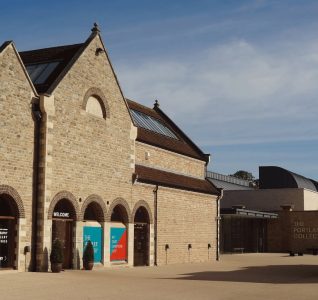
The World’s Mine Oyster: Art, Nature and Collecting the Globe at the Harley Foundation, North Nottinghamshire, reveals the stories of this world-class collection.
The Portland Collection, built up over 400 years by the Cavendish family and their descendants, is vast and varied. Exhibitions in its dedicated museum change every three years.
For this display, opening 20 March 2026 exactly 10 years after it opened to the public in 2016, visitors will learn the stories behind the collection for the first time. Bringing together previously untold stories and new research, this exhibition explores how the Cavendish family saw and used the natural world, both at home and across the world.
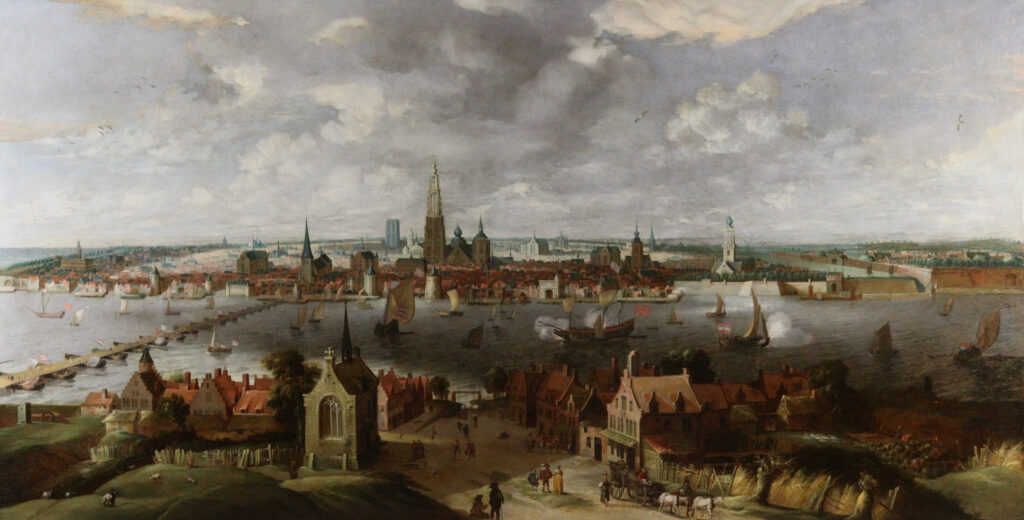
At the heart of the display is the newly restored A View of Antwerp. Never publicly shown before, this 3-metre-wide painting was once thought to be a generic cityscape – but conservation and recent scholarship reveals that it captures the arrival of Prince Ladislaus of Poland in Antwerp on 22 September 1624. Teeming with detail, experts agree that the painting is a collaboration between multiple artists, but debate their identity.
Alongside it hang portraits of women who have shaped the collection: Bess of Hardwick; Margaret Cavendish, Duchess of Newcastle; Margaret Cavendish-Bentinck, Duchess of Portland; and Winifred Cavendish-Bentinck Duchess of Portland.
One was the first ever writer of science fiction, one amassed the largest collection of seashells in Europe, and one was a champion of animal welfare – whilst married to an avid hunter. For these women and their descendants, nature could be many things at once: a source of beauty, a subject for study, a way to earn money, a chance to do good, and a symbol of power and status.
Bryony Bond, Director of the Harley Foundation explains:
“The collection is astonishingly varied and encompasses so many stories, from how raw materials were sourced, to the skilled makers and artists behind each artefact, to the lives of the people who collected, studied, wore and used these objects. This display begins to explore some of these stories, showing how Welbeck connects to the world and the legacies of colonialism.”
Highlights from The World’s Mine Oyster: Art, Nature and Collecting the Globe include:
- Madonna del Silenzio, Michelangelo Buonarroti, 1538 – 1540. A star object of the Portland Collection, the Silenzio is not the Michelangelo of popular imagination – and a new video by Michelangelo expert Grant Lewis explores whom the drawing may have been made for and why.
- In the spirit of Margaret Cavendish-Bentinck, Duchess of Portland’s Portland Museum, the display features a stacked cabinet of curiosities. Objects include: Roman cameos, a jewel-encrusted dagger once believed to belong to Henry VIII, books, natural history specimens, and paintings, all surrounding a portrait of the collector herself.
- A View of Antwerp, Unknown Artists. Never publicly shown before, this painting has undergone recent conservation, and research by Dr Lauren Batt has revealed that it captures a specific, historically significant moment: the arrival of Prince Ladislaus of Poland in Antwerp on 22 September 1624. Previous attributions have included Peter Paul Rubens, Jan Brueghel the Elder and Sebastiaen Vrancx, who were involved in Prince Ladislaus’ visit.
- A shoehorn engraved with the Cavendish arms, 1594. One of the oldest objects in the collection, this shoehorn was made during the lifetime of Bess of Hardwick. It was later gifted to the Marquess of Titchfield (Bess of Hardwick’s 9x great grandson) in 1915, nearly 300 years after it was made.
- Portrait of Margaret Cavendish, Duchess of Newcastle (1623-1673), Sir Peter Lely, 1665. This much-loved portrait of Margaret Cavendish returns to public display alongside objects related to Charles I (including the pearl earring worn to his execution). Cavendish was the first woman to attend a meeting of the Royal Society, to publish a work of philosophy and science in English and to write a work of science fiction.
- Paintings by John Wootton of a Brown Wolf and Antelope, thought to be painted from life at Wimpole Hall, Cambridgeshire. Recent research by Dr Lauren Hennelly (University of Copenhagen) suggests the wolf is an Indian wolf – the world’s oldest wolf lineage, now endangered with only about 2,200 remaining.
The World’s Mine Oyster: Art, Nature and Collecting the Globe opens at the Harley Foundation North Nottinghamshire on 20 March 2026, free entry.
- The World’s Mine Oyster: Art, Nature and Collecting the Globe will open 20 March It will be on show until 8 April 2029.
- The exhibition will include works of art that have not been exhibited publicly before, accompanied by other important pieces from this world class art collection. For the first time, it will be shown alongside new research revealing the histories of the objects.
- The exhibition is free to enter and there is a large, free car park. The gallery is open 7 days a week.
- The Harley Foundation is located on the historic Welbeck estate, on the A60 south of Worksop. It is 15 minutes from both the A1 and M1.
Posted on 07 January 2026